Blog · Process mapping
What is the difference between cycle time, lead time and touch time?
Three measures that sound alike and mean different things. Cycle time belongs to a step, lead time to the whole flow, touch time to the hands. The gap between the last two is where waiting hides.
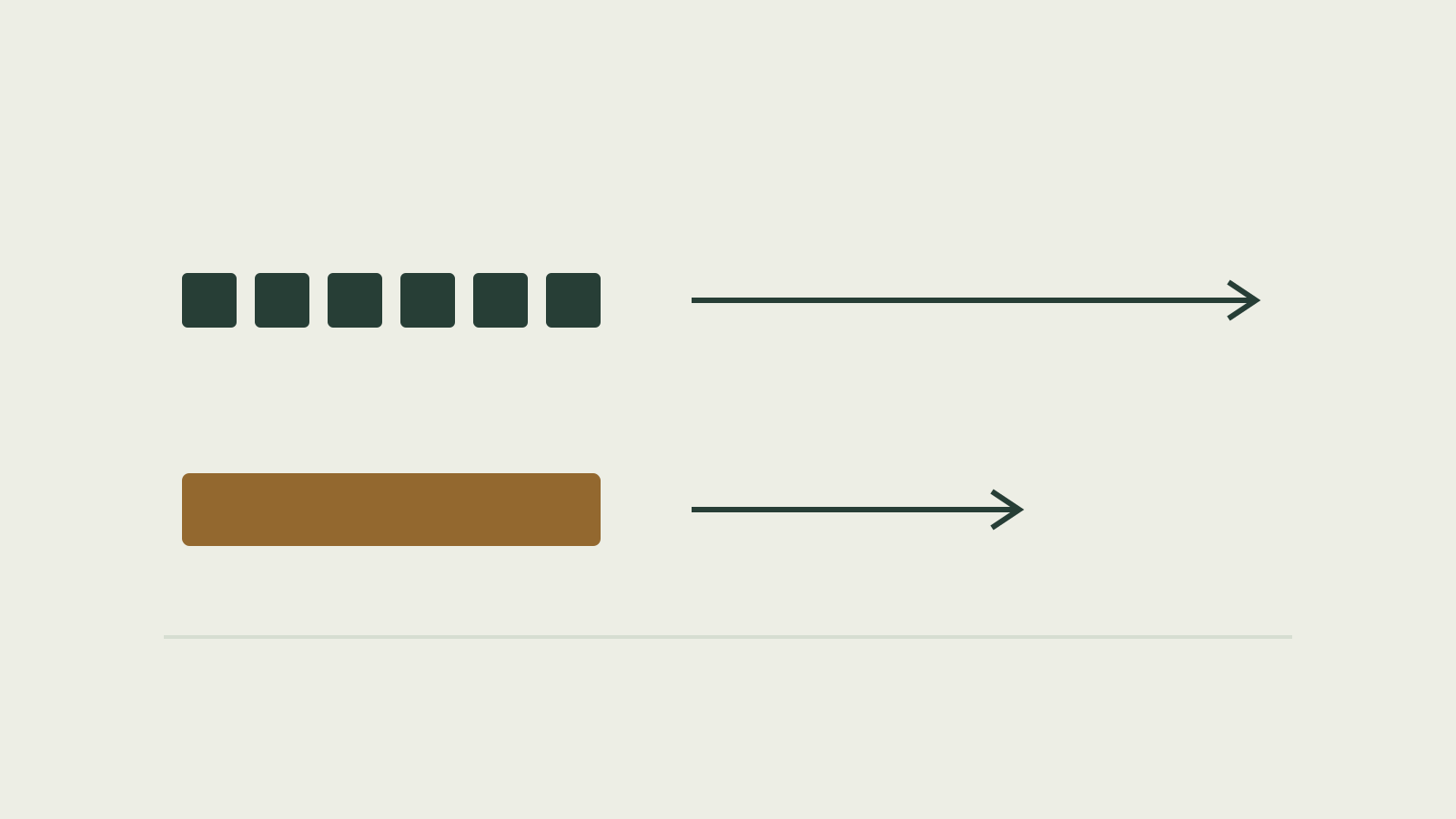
Cycle time is how long one unit takes from the start to the finish of a single step. Lead time is how long the whole flow takes from request to delivery. Touch time is the hands-on work that happens inside that flow. They are measured separately because they answer different questions: cycle time tells you about a step, lead time tells you what the customer experiences, and the gap between lead time and touch time tells you how much of the customer's wait is spent waiting rather than being worked on.
Mara Lindqvist · Independent operations consultant · · 3 min read
Last updated
Why do these three get confused?
Because in everyday speech they all mean "how long it takes". On a depot floor they are three different clocks, and an improvement plan that uses the wrong one will improve the wrong thing.
I was caught by this myself in a practice set earlier this year. The question asked which measure changes when the constraint is improved, and I answered with the wrong one. The habit of keeping the three apart is something I now practise deliberately.
What is cycle time?
Cycle time is the time one unit takes from the start to the finish of one step. If a receiving clerk takes a pallet from the dock door, checks it against the booking and scans it in, the cycle time of receiving is the time from picking up that pallet to putting the scanner down.
It belongs to the step. It says nothing about how long the pallet waited at the dock door before the clerk reached it.
How do you measure it?
With a stopwatch, on real units, several times, across more than one shift. One timing is an anecdote. A spread of timings tells you how stable the step is, and an unstable step is often more trouble than a slow one.
What is lead time?
Lead time is from request to delivery across the whole flow. For an inbound delivery it starts when the vehicle is booked in and ends when the stock is available to pick. It is the measure the customer feels, because the customer does not see your steps, only the wait.
Lead time includes every queue. That is the point of it.
Why is lead time usually much longer than the sum of the cycle times?
Because of waiting. Units sit at the dock door, sit in the put-away lane, sit in staging. Add up the cycle times of the steps and you get a number that looks respectable. Measure the lead time and you get a number several times larger. The difference is not a mistake. It is the queue.
What is touch time?
Touch time is the hands-on work inside the flow: the minutes in which someone is actually doing something to the unit. It is usually a small fraction of the lead time, and showing a client that fraction for the first time is one of the more useful moments in a review.
Where does waiting hide?
In the gap between lead time and touch time. If a delivery has a lead time of a shift and a touch time of a few minutes, almost all of that shift is waiting. Waiting is what the customer feels, and it is also the cheapest thing to remove, because nobody has to work faster. The work simply has to stop sitting still.
Which measure changes when you improve the constraint?
Throughput: the rate at which finished work leaves the system. Not the cycle time of the fastest step, not head count, not the number of procedures. If a change at the constraint does not move throughput, it was not a change at the constraint.
This matters for improvement plans. A plan names a measure, and if the named measure is the wrong clock, the review at the end will show effort and no result.
How do I use the three together?
- Map the flow and mark the queues.
- Time the cycle time of each step on real units.
- Measure the lead time end to end.
- Work out the touch time and compare it with the lead time.
- Find the step where work queues longest. That is where to look for the constraint.
Q&A
The questions I am asked most about these three measures are answered below.
Last updated 1 October 2026.
Questions and answers
- Is cycle time the same as takt time?
- No. Cycle time is how long one unit takes through one step as it is done today. Takt is a target pace derived from demand. A current-state map records cycle time; targets come later.
- Why measure touch time if it is so small?
- Because comparing it with lead time shows how much of the customer's wait is waiting rather than work. That comparison is usually the strongest argument for attacking queues before speeding up steps.
- Which of the three should a client track every week?
- Lead time, because it is what the customer experiences, and throughput at the constraint, because that is what changes when the constraint is improved.
- Can lead time be shorter than the sum of the cycle times?
- Only when steps run in parallel. In a single flow through receiving, put-away and staging the lead time is the cycle times plus every queue between them.
#cycle time #lead time #touch time #measurement #process mapping
Related articles
Process mapping
How do you map a process as it actually happens?
A current-state map is a record of the floor today, not a tidy version of the written procedure. Here is how I build one in a depot: walk the process, time the steps, mark the queues, and confirm it with the people doing the work.
Mara Lindqvist · Independent operations consultant · · 3 min read
Constraints and flow
What goes into an improvement plan that actually works?
A plan without a measure is a wish. A working plan names the constraint, the measure that will show the change, the owner and the review date, and it is piloted on one shift before it is rolled out.
Mara Lindqvist · Independent operations consultant · · 3 min read